
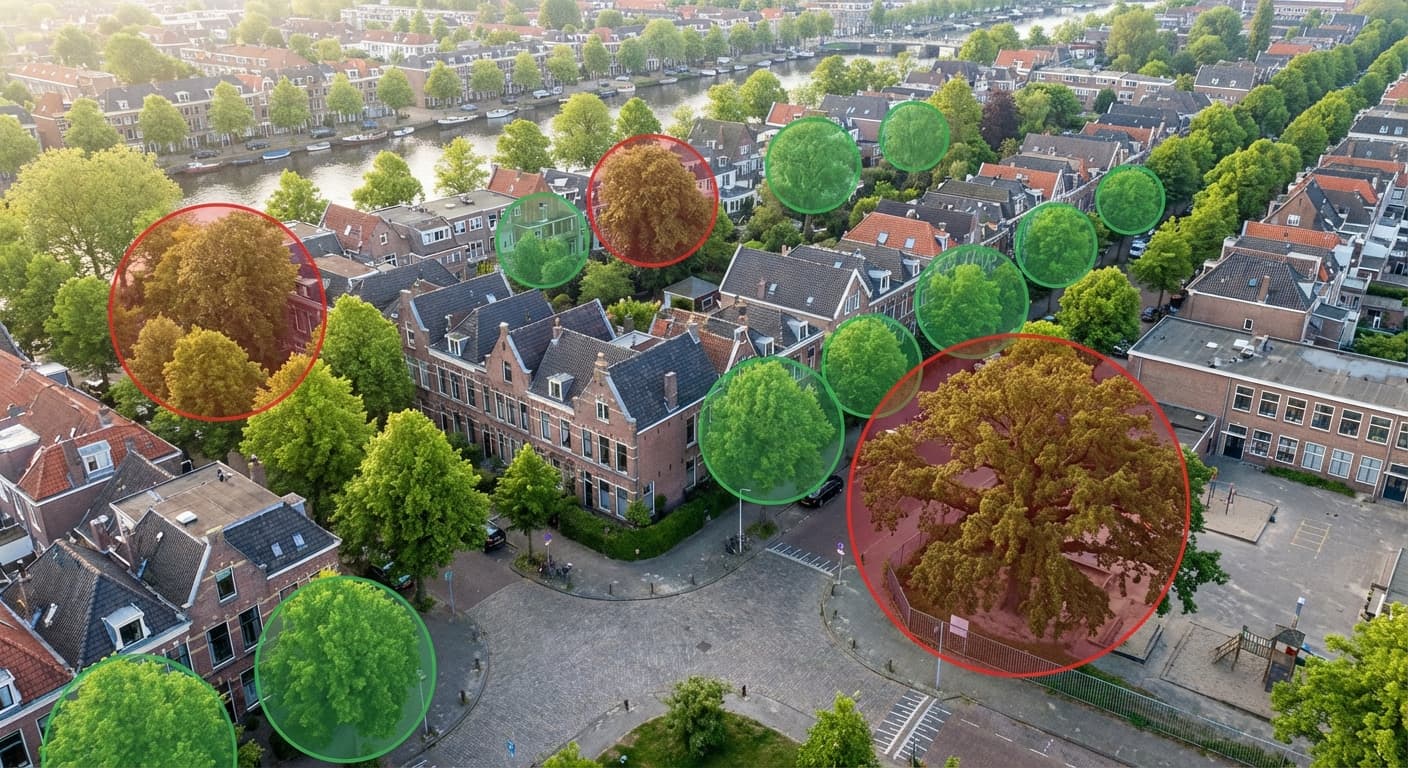
From 20,000 risk trees to data-driven priorities
A Dutch municipality faced a familiar problem: after the annual VTA inspection, the number of risk trees far exceeded the available maintenance budget. With IDA's Smart Risk Prioritization, they got objective, defensible choices for the first time.
Too many risk trees, too little budget
The annual VTA inspection revealed that the number of risk trees significantly exceeded what the maintenance budget could handle. Although managers had been doing their best for years to set the right priorities, there was no objective method to explain to the council and residents why some trees needed immediate attention while others could wait.
The numbers were clear: 20.000 identified risk trees, but budget for only {count2}. Which half takes priority, and how do you explain that?0 identified risk trees, but budget for only 10.000. Which half takes priority, and how do you explain that?0. Which half takes priority, and how do you explain that?
Smart Risk Prioritization with IDA
With IDA's Smart Risk Prioritization module, the municipality got a clear picture of the actual risks in their tree inventory for the first time. Existing VTA data was enriched with a risk prioritization score that gave each tree one transparent risk score.
Each tree received a score based on: tree height and fall zone, location and surroundings, traffic density, potential consequential damage, and the probability that something would actually be hit if it failed.
Which 10,000 do you choose? No objective basis.
Exactly the trees that remove the most risk.
From data to action in five steps
Those risk scores proved to be a breakthrough. Instead of working from intuition, the municipality could align maintenance with the available budget. By setting a risk threshold, only trees that fit within the budget and delivered the greatest risk reduction were automatically selected.
From this selection, a complete project was created with just a few clicks, including a map view of the relevant locations. The green contractor seamlessly took over execution, in IDA, they could see exactly which trees needed treatment and what measure was required for each tree.
Immediately noticeable impact
The effect of this approach was immediately noticeable. Where there used to be much discussion about priorities, there was now peace and trust thanks to the substantiated choices that IDA made visible.
The maintenance budget was fully utilized, risky situations were demonstrably addressed faster, and the municipality could clearly explain to the council and residents why certain streets received maintenance this year and others would follow next year.
After completion, the entire tree inventory was automatically up to date in the system, ready for the next cycle.
Want smarter prioritization for your tree inventory?
This case shows how a municipality gained control over a structural problem: too many risk trees and too little budget. With Smart Risk Prioritization, IDA made it possible to make data-driven, transparent choices that hold up to scrutiny and demonstrably reduce risks.
Want to see what this would look like for your municipality? Request an (online) demo.