
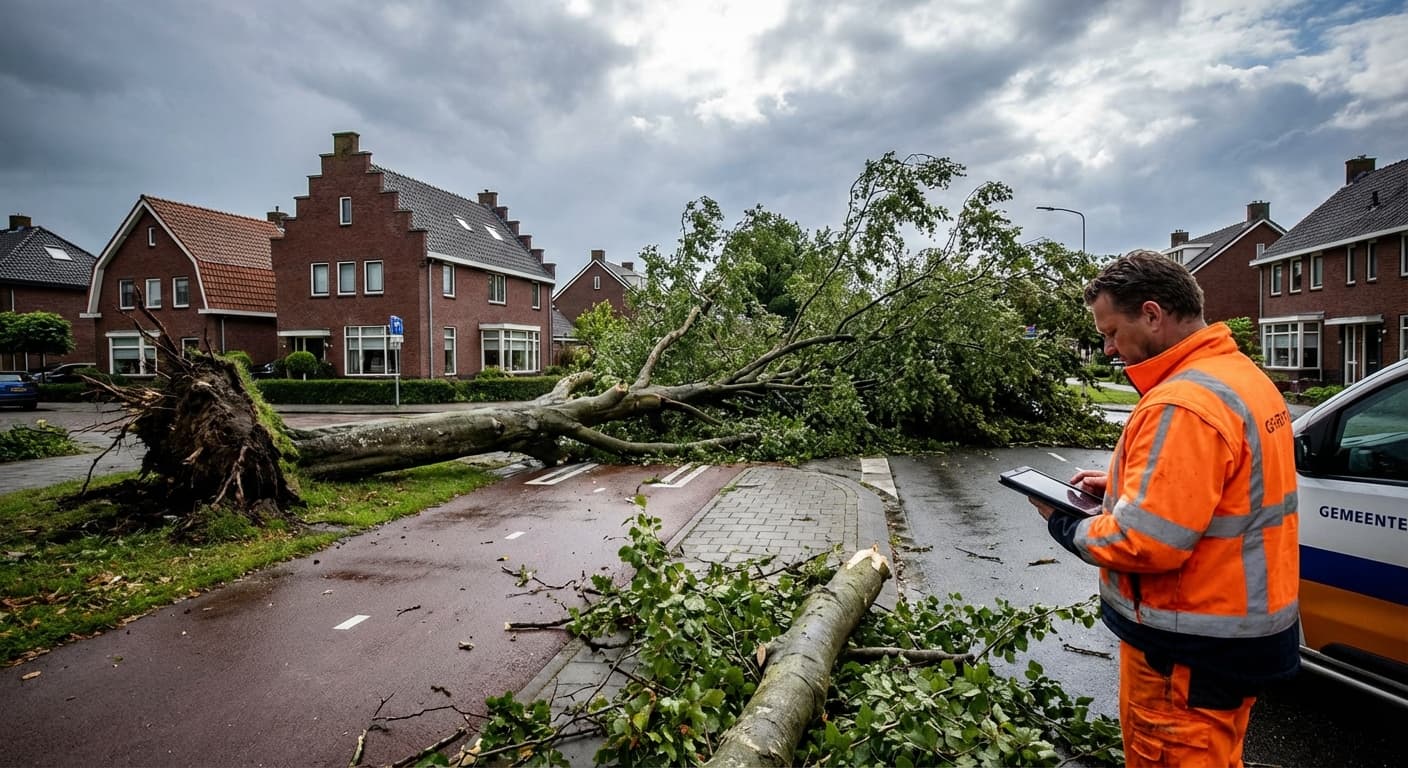
When a tree falls, every minute counts
The notification came in at 06:12. A fifteen-meter beech, completely on the street. Linden Lane, near number 34. No injuries, but a Volkswagen Polo with a crushed roof.
The question that always comes
Marieke van den Berg, green space manager at a mid-sized municipality, saw the photos on her phone while still in her car. The tree lay across the road, its root ball upturned like an open wound. She knew that tree. Years ago, she had inspected it herself.
Marieke manages a tree inventory of 23,000 specimens. Two part-time field workers, a contractor for the larger jobs, and herself for everything in between: policy, complaints, coordinating inspections, answering council questions.
At half past ten, the car owner's insurer called. The question was predictable, and Marieke had heard it dozens of times in her career:
“Can you prove this tree was inspected? And that the municipality acted on the findings?”
It's the question every tree manager dreads. Not whether a tree will eventually fail, that's statistically inevitable with tens of thousands of trees. But whether you can show you did your job.
Searching for the past
Three years ago, Marieke had been in the same situation. An elm on a school playground, branch broken off, child slightly injured. The question came, and then the searching began.
The last inspection was in an Excel file on her predecessor's computer. The photos were somewhere on a shared drive, but no one remembered which folder. The quote for the pruning that was done? Three phone calls to the contractor and eventually a scan of an invoice. The note about why the tree wasn't felled at the time? No one knew anymore.
It had taken her four days to compile a dossier. Four days during which the alderman called three times. Four days of not knowing whether that dossier would protect the municipality or damage it.
In the end, it worked out. But the taste lingered.
A different approach
Two years ago, Marieke decided she didn't want to end up in that situation again. No more searching through archives while a lawyer waits for answers. No more hoping that a colleague from five years ago had saved their photos properly.
She looked for a way to record every inspection, every pruning job, every decision in one place. Not as an administrative obligation, but as protection. For the municipality, and honestly, for herself too.
She chose IDA. Not because it was the only solution, but because it was the simplest. Her field workers were using the app after just an afternoon of explanation. Every tree got a timeline. Every inspection got a photo and a conclusion. Every decision got a name and a date.
10:47 AM, Linden Lane 34
Back to that morning. Marieke sits at her desk, the phone still warm from the call with the insurer. She opens IDA, types in the tree number.
Beech #4892. Linden Lane 34.
VTA inspection. Condition fair, no defects found. Photo of trunk, photo of crown. Inspector: J. Hendricks.
Pruning completed. Crown reduction 15%. Performed by Tree Care Limburg. Work order attached.
VTA inspection. Minor trunk damage on east side, likely mower damage. No acute risk, reassessment recommended within 12 months. Photos attached.
Reassessment completed. Damage stable, no expansion. Conclusion: retain, regular inspection schedule.
Tree blown over during November storm
Marieke exports the dossier as PDF. Seven pages. Photos, dates, names, conclusions. The complete story of a tree that was properly managed for five years, until last night's storm.
At 10:54, she sends the email to the insurer.
What's different now
At three o'clock, the insurer calls back. Could she clarify one thing: who made the decision to retain the tree after the reassessment?
Marieke scrolls to the relevant inspection. "That was our tree safety inspector, Mr. Janssen. His VTA certification is in the report. The decision was based on the guidelines from the Tree Handbook."
Silence on the other end. "That's clear. We'll let you know if we need anything else."
The claim is rejected three weeks later. The municipality had demonstrably fulfilled its duty of care.
Marieke has been working with the system for three years now. She doesn't think about it much anymore. Her workers register their inspections in the field, the photos are automatically linked to the right tree, and when someone asks why a particular tree was or wasn't pruned, the answer is just a few clicks away.
Recently, a council member asked during a committee meeting how many trees had been felled in the past year and why. That used to be a question that took half a day. Now she shared her screen, filtered by "removed" and "2024", and scrolled through the list. Every tree with a reason, a photo, and an approval.
At quarter past five, Marieke closes her laptop. Linden Lane has been cleared, the insurer has what they need, and tomorrow a new tree will be planted.
She thinks for a moment about her predecessor, who kept everything in Excel and saved photos on a hard drive. He did his best too. Everyone did their best. It just was never enough when it mattered.
Now it's enough.
Want to make sure it's enough when it matters?
Request a free demo and see what a tree dossier looks like in IDA.