Municipal tree management: how a local authority runs it
Municipal tree management is a cycle: knowing which trees you have, inspecting them, planning maintenance and having it carried out, and recording what was done. It works when policy, tree inventory and execution connect, and when you can show for every tree what you knew and what you did. This article describes how Dutch municipalities do it.
6 min read


What municipal tree management involves
Municipal tree management is all the work needed to keep a local authority's trees safe, healthy and up to number. That is more than pruning. You know which trees you have, you inspect them, you plan maintenance and have it carried out, you replace what is lost, and you record what you did. This article describes how Dutch municipalities organise it; the terms and rules are those of the Netherlands.
The recording is part of it because the municipality owns the trees on its land. Whoever owns a tree has a duty of care: you have to take reasonable measures to prevent damage, and you have to be able to show afterwards that you did. How that works in Dutch law is explained in the article on the duty of care for trees.
Tree management is also a financial and political task. Trees give shade and cooling, they cost maintenance every year, and residents watch every felling closely. A municipality that knows its trees well can explain why it does something, and what it costs not to.
From policy to management plan
Tree management usually sits in a few documents, from general to specific. The names differ per municipality, the layers do not:
- Tree policy (bomenbeleidsplan)
- The long-term vision, usually adopted by the council: how many and which trees the municipality wants, where it protects trees, and how it deals with felling, replanting and trees on building sites.
- Tree management plan (boombeheerplan)
- The policy worked out for the tree manager: which trees there are, how often you inspect which group, what maintenance each group gets, and what that takes in work and money per year.
- Felling rules
- When felling a tree needs a permit. Inside the bebouwingscontour houtkap, the built-up area boundary for felling, the Dutch municipality decides that itself, in its omgevingsplan (the local environment plan). Outside it the national rules apply, with the province as the competent authority.
- Specification or contract
- The agreements with the contractor who carries out the work: which work, at what price, which quality requirements it has to meet and how you check that.
The felling rules under the Dutch Environment and Planning Act (Omgevingswet) are explained by the Informatiepunt Leefomgeving (in Dutch). For the quality requirements of the work itself, many municipalities refer in their specification to Handboek Bomen, the Dutch reference work for tree care and tree inspection published by the Norminstituut Bomen (in Dutch).
A management plan is as good as the tree inventory it rests on. If half the trees are missing from it, or listed with a condition from ten years ago, you are planning by feel. In IDA Bomen that inventory sits on one map, and every value knows its date and its source.
The tree management cycle
Tree management is cyclical: the same round, again and again, with each step feeding the next.
Inventory
You record which trees there are, with species, dimensions and location. After that you keep the inventory up to date: new planting in, felled trees out.
Inspect
A tree safety inspection, BVC in Dutch, gives every tree a safety class and an advice. How often you inspect is set in your management plan, per group of trees and by risk.
Plan
The advice and the regular maintenance produce the work for the coming year: formative pruning of young trees, maintenance pruning, felling, closer examination. Urgent measures come first.
Carry out
An in-house crew or a contractor carries out the work and reports per tree what was done.
Review and update
You check the work, process the outcome in the inventory and close the measure. Only then is the tree up to date again.
Replace
For trees that are lost you plant new ones, with aftercare in the first years. The new tree goes into the inventory, and the cycle starts again.
In IDA every round in this cycle is a project: a group of trees, a type such as BVC, pruning or planting, and a form. What exactly is recorded during the inspection is covered in what a tree safety inspection is. How you get to a reliable inventory is covered in creating a tree inventory.
Who does what
In a small municipality it is one person with a contractor, in a large one a team. The roles are the same:
- The tree manager owns the inventory and the management plan. They decide which work is coming and review what comes back.
- The tree inspector carries out the inspections, employed by the municipality or by a consultancy.
- The contractor carries out pruning, felling and planting, often under a specification that runs for several years.
- The supervisor checks the work outside on behalf of the municipality.
- Executive and council set policy and budget, and get the questions from residents.
In IDA the contractor works in your inventory, with access to their own projects only. How to set up that cooperation is covered in working with a contractor.
Where it goes wrong in practice
On paper it is often fine. It grinds in the execution, and usually in the same places:
- The inventory lags behind. Trees have been felled and planted, but the register does not know. The next inspector looks for trees that are no longer there.
- Findings are left lying. The inspection is done and the report is in, but nobody sees which risk trees (risicobomen) have not had a measure yet. Legally that is the weakest spot: you knew, and you did nothing.
- The knowledge is in people's heads. One colleague knows why that avenue is pruned differently. When they leave, it leaves with them.
- Every contractor delivers differently. A spreadsheet here, a PDF there. Processing it takes time, and meanwhile the inventory is out of date.
- The budget has no underpinning. Without figures on condition, age and backlog, every budget round is a negotiation by feel.

Accounting for what you did
Sooner or later the question comes: from a councillor, a resident, an insurer or a court. A municipality that has its tree management in order can show four things without searching:
- Per tree: when it was inspected, by whom, what was seen and what was done next.
- For the whole inventory: how many trees there are, in what condition, and how many measures are open.
- Over time: whether the backlog is growing or shrinking.
- About the money: what maintenance costs, and what postponing means.
The first is for the damage claim, the other three are for the budget and the council. For the first, IDA exports a tree's timeline as a PDF, with photos and approved deviations. After a storm all four come together. What is expected of you then is covered in the article on storm damage to trees.
Tree management in IDA
IDA is tree management software for municipalities and their contractors. It follows the cycle above. We migrate your existing tree inventory for you, whether it is a shapefile from your GIS or an Excel list. That is part of onboarding. The inspector or the contractor fills in the form of their project in the field, on a phone or tablet.
What comes back, you review. New trees from an inventory round and deviations from the register go into a queue, and only enter the register after your approval. Every value of a tree keeps its provenance: which inspection or project it comes from, by whom and when.
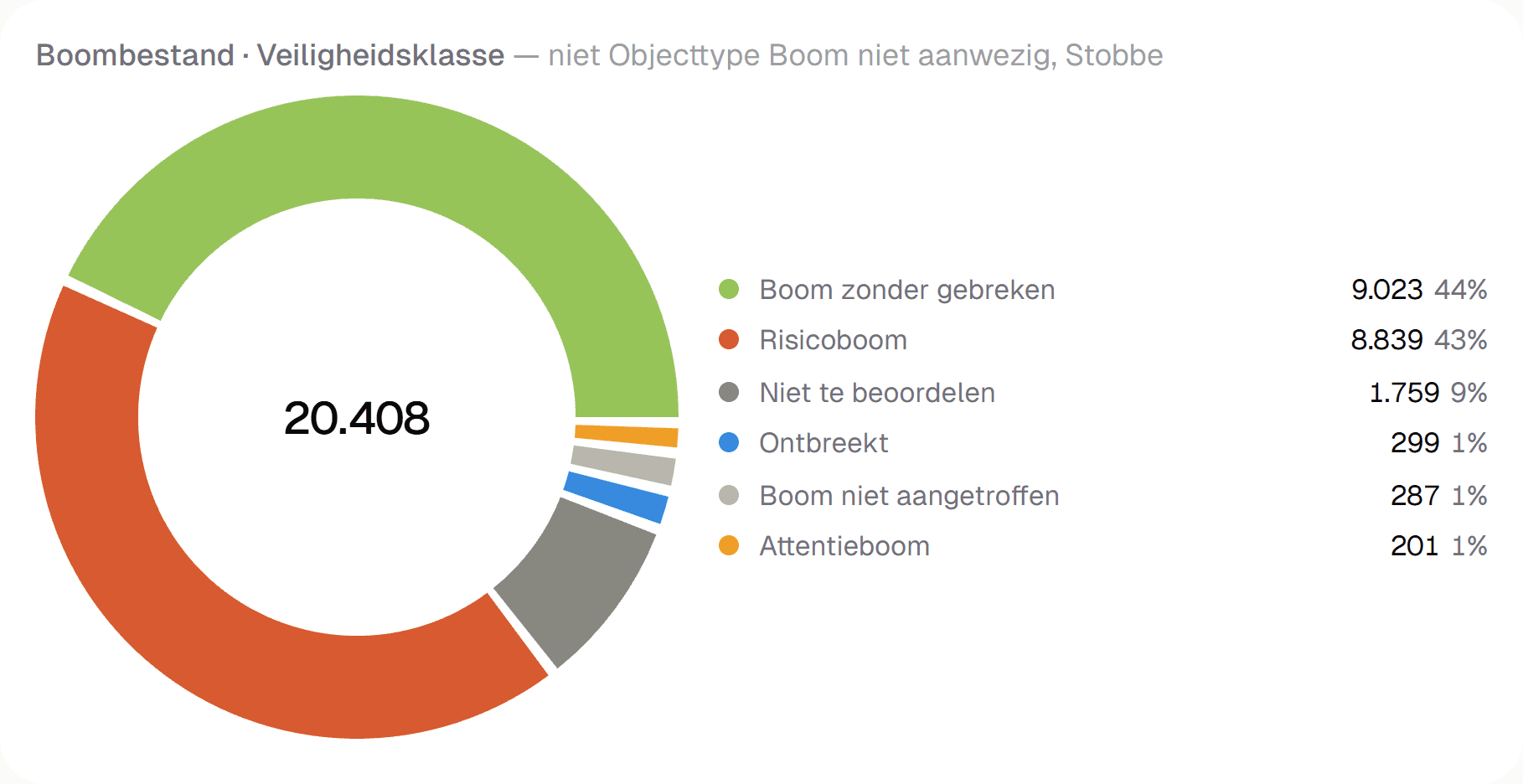
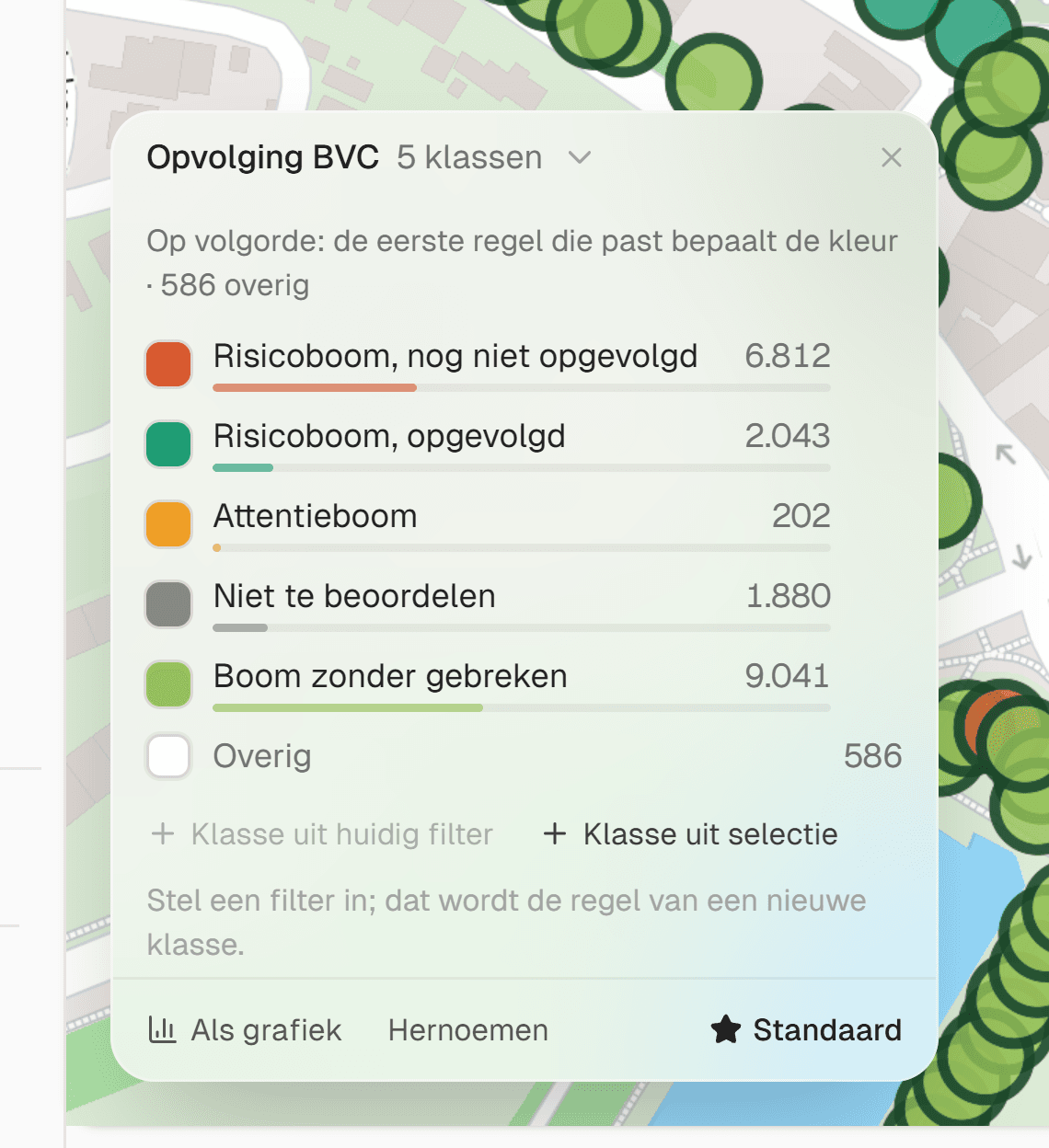
To account for your work you colour the map by follow-up, so open risk trees stand out. Saved selections appear as charts on the dashboard: the course of the backlog, or the distribution per district. In the planning view you see the projects per type on a timeline, with what is overdue. And with an imported RAW-bestek, the Dutch standard form of specification, IDA calculates the cost of a selection of trees against the prices in your contract.
You set the frequency in your management plan. With a saved selection, such as all trees whose last inspection is older than the interval in your management plan, you see which trees are due.
Frequently asked questions
The tree policy, bomenbeleidsplan in Dutch, is the long-term vision: which trees the municipality wants, where it protects trees and how it deals with felling and replanting. The tree management plan, the boombeheerplan, works that out for the tree manager: which trees there are, how often you inspect them, what maintenance they get and what that costs per year.
No Dutch law names an interval. The municipality sets a reasonable frequency itself, depending on the location, the age and the condition of the trees, and records it in the management plan. Trees with a defect you want to follow are inspected more often. What counts is that you demonstrably carry out your own policy.
Yes, both the inspections and the maintenance are often outsourced to consultancies and contractors. The duty of care stays with the municipality as the owner of the trees. So agree that all findings and all work carried out end up per tree in the municipality's inventory. In IDA Bomen the contractor works in that inventory, with access to their own projects only.
In principle one looks to the owner of the tree, so the municipality. The question then is whether the municipality met its duty of care: was the tree inspected regularly, and was something done with what was found? If you can show that per tree, you are in a strong position. IDA Bomen keeps per tree when it was inspected, by whom and what was recorded afterwards.
The municipality decides that itself for trees inside the bebouwingscontour houtkap, the built-up area boundary for felling, in its omgevingsplan. One municipality works with a list of protected trees, another with a permit requirement from a certain stem thickness. Outside that boundary the national rules for stands of trees apply, with a duty to notify the province and a duty to replant.
Read on
Duty of care for trees: what Dutch municipalities record
In the Netherlands the duty of care for trees follows from article 6:162 of the Civil Code. When a municipality is liable, and what you record per tree.
8 min read
What is a tree safety inspection (BVC)?
A tree safety inspection (BVC in Dutch) is the visual check of a tree for defects that pose a danger. What you assess, record and follow up, and why.
4 min read
Outsourcing tree maintenance: working with a contractor
Outsourcing tree maintenance to a contractor: what goes in the specification, how assignment, report back and settlement run, and how to handle deviations.
7 min read


See your own tree inventory in IDA
Send us your tree inventory, as a shapefile, an Excel list or whatever you have, and we will show IDA on your own trees, from your own file to the approval of field work.
Used by