Storm damage from trees: who is liable in the Netherlands?
This article describes Dutch law. If a tree blows over and causes damage, the owner is only liable if he breached his duty of care. For a municipality, storm damage therefore turns on two things: what you knew and did about the tree before the storm, and what you record after it.
8 min read

Who is liable for storm damage caused by a tree
This article describes the law and the practice in the Netherlands. There, the owner of a tree is only liable for storm damage if he breached his duty of care (zorgplicht), a duty comparable to the one a tree owner has in the UK. That is the case if he did not inspect the tree, or not often enough, or knew of a defect and did nothing about it. If an inspected tree without known defects blows over, the injured party bears the damage, usually through their own insurance.
There is no strict liability for trees. The basis is article 6:162 of the Dutch Civil Code (in Dutch), the tort provision, and that requires fault. In everyday speech a storm is then called force majeure. Legally it is more precise to say that without a breach of the duty of care there is no tort. How that duty is built up is explained in the article on the duty of care for trees.
The Arnhem-Leeuwarden Court of Appeal (gerechtshof) applied this to a municipal tree in 2020. In August 2017, at a wind speed of 19 metres per second, a heavy branch of a maple fell on a parked car in Hilversum. The municipality inspected its trees once every four years, and yearly where the danger was heightened. This tree had been inspected by a tree specialist in June 2015. The car's owners could not substantiate that the municipality should have examined the tree more often. The municipality was not liable. IDA Bomen keeps that proof per tree: every tree safety inspection, with the date, the inspector and the outcome.
When it counts as a storm
It depends on who you ask.
- KNMI
- For KNMI, the Dutch national weather service, a storm is wind force 9 or more: an average wind speed of 75 to 88 kilometres per hour, measured over an hour. Wind force 10 is a severe storm, wind force 11 a very severe storm.
- Gusts
- From 75 kilometres per hour KNMI speaks of severe gusts, above 100 kilometres per hour of very severe gusts.
- Insurers
- According to the Dutch consumer association Consumentenbond, insurers already speak of a storm from wind force 7. That decides whether a policy covers storm damage, not who is liable.
KNMI warns with colour codes. Code yellow for gusts applies from 75 kilometres per hour, code orange from 100 kilometres per hour; on the coast those thresholds are 90 and 120 in the winter half of the year. Code red is a weather alarm: extreme weather with major consequences for society. At code yellow KNMI itself already mentions the chance of accidents from breaking branches, at orange and red from trees blowing over. The current explanation is on the KNMI page on gusts and storms (in Dutch).
According to KNMI the storm season starts in September, and the heaviest storms fall from October to March. For trees a summer storm, between April and September, is at least as hard. Trees are then in full leaf, catch a lot of wind and lose branches more easily, especially when it also rains hard. The branch in Hilversum broke in August.
Before the storm: what you arrange in advance
What you can show after a storm is what you did in the months before it.
- Follow up your risk trees before the storm season. Every piece of advice from a tree safety inspection that is still open is your weak spot after a storm.
- Know where your attention trees and risk trees are (attentiebomen, trees with a defect you are following, and risicobomen), and which of them stand along main routes, schools and busy places. That is where you look first after a storm. In IDA you colour the map by safety class (Veiligheidsklasse) and select the trees along a route with a drawn area.
- Agree with your contractor who turns out when: availability outside working hours, who gives the order, and how the work is recorded. See working with a contractor.
- Record where reports come in and who assesses them. A report about a dangerous tree that nobody picked up weighs heavily later.
- Decide in advance what you do at code orange and red, for example whether you close parks, cemeteries or events under trees.
During the storm
During the storm safety comes first: that of road users, and of your own people and the contractor's. Nobody inspects or saws under swaying crowns, except where the emergency services ask for it. Cordon off what is dangerous and clear what has to be clear.
One thing can be done straight away: keeping track of what comes in. Per report, note the time, the place and what is going on, preferably with a photo. Afterwards that list is your work queue and the start of your record.
After the storm: inspect, clear, record
Make safe
Clear what lies on roads, paths and buildings and cordon off what can still fall: hanging branches, torn scaffold limbs, trees that have started to lean.
Inspect with focus
First walk the heavily used places and the trees that were already known as an attention tree or a risk tree. Look at the crown, and at the ground around the stem base: cracks in the soil or a lifted root plate point to a tree that has come loose.
Record per tree
For every tree that blew over or was damaged, record: date, place, photos, the type of damage (uprooted, stem failure, branch failure), what was visible at the fracture surface or the roots, and what was done about it.
Update the register
Take trees that are gone out of the inventory, add new defects to the trees that are still standing, and plan the repair work and the replanting. A tree inventory that was not updated after a storm is no longer right at the next inspection.
The fracture surface and the root plate tell whether the tree was healthy. A photo of them, taken before the tree is removed, cannot be taken afterwards. In IDA's field app the crew takes that photo at the tree, and it then sits in the record with its date. If a tree has to go urgently, check what emergency provision your own felling rules contain and record why it could not wait.
Handling a damage claim
Someone with damage reports it to their own insurer first. According to Consumentenbond, storm damage to a home in the Netherlands falls under buildings or contents insurance. A car is covered by limited comprehensive (beperkt casco) or fully comprehensive insurance, not by third-party cover alone. If the injured party or the insurer then holds the municipality liable, they have to substantiate that the municipality fell short.
Your answer is the record of that one tree:
- the policy: how often you inspect these trees, and why;
- the last inspection: date, inspector, safety class and defects;
- advice and what was done with it, with dates;
- reports about this tree and how they were handled;
- the photos and the records from after the storm.
If you can produce that within a day, you are in a strong position. IDA exports a tree's timeline as a PDF, with photos and approved deviations. If you have to gather it from three parties, you already have a problem, whatever the outcome. A complete and current tree inventory is the basis; see mapping a tree inventory.
How that goes on the day itself, from the notice of liability to the exported dossier, is in the scenario on the tree dossier for a damage claim.
Recording storm damage in IDA
In IDA all trees are on one map, and every value carries its provenance: which inspection it comes from, by whom and when. The PDF of the timeline is the document you produce in a claim.
After a storm you select the affected trees on the map, with a drawn area, a radius around an address or a filter on safety class. You turn that selection into a project for the clearing or the follow-up inspection, and you give the contractor access to that project alone. Trees that are gone, you archive in one action.


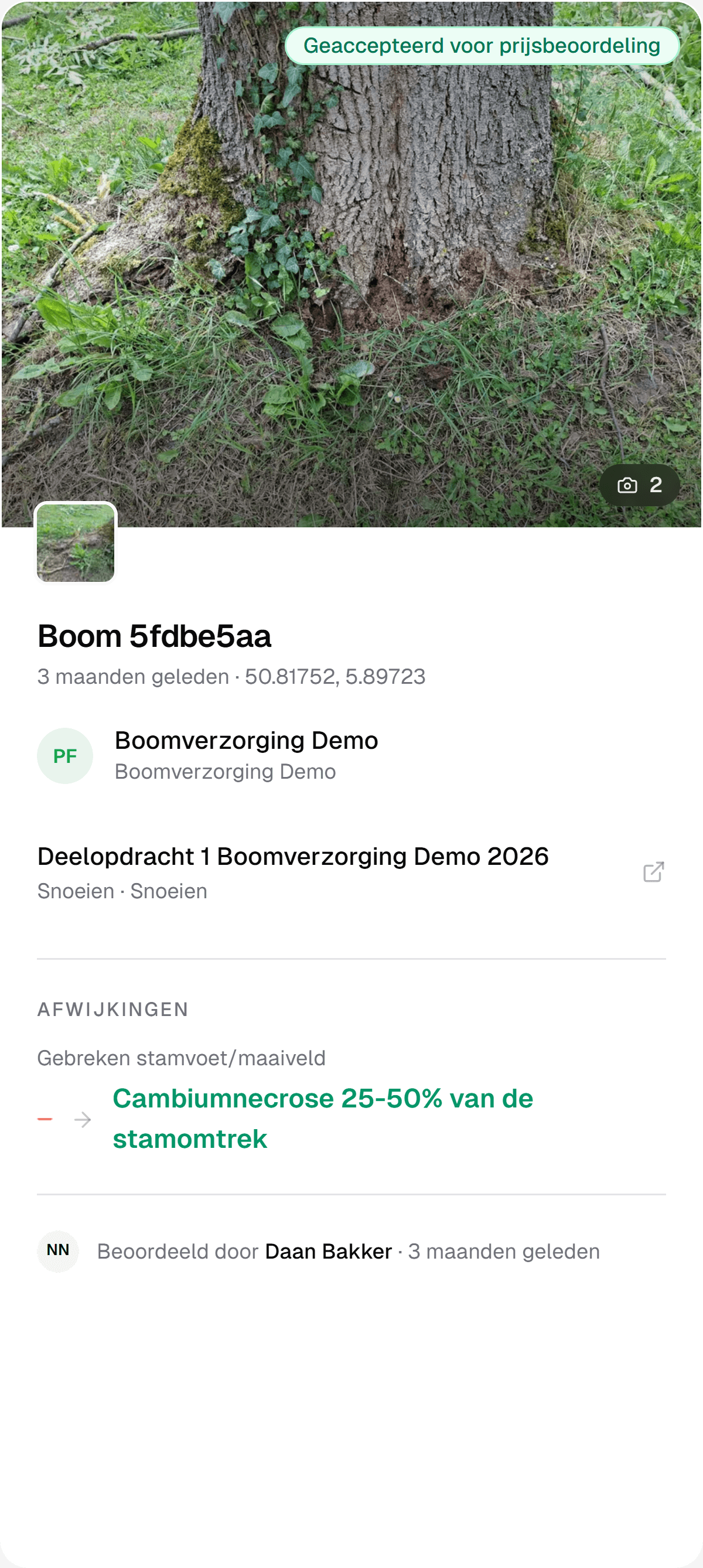
In the field the crew works on a phone or tablet, without installing anything. Per tree they record the work with photos from the camera and set a status. If someone sees a defect that is not in the register, such as a crack or a damaged stem base, they report a deviation (Afwijking melden) with mandatory proof photos. It only enters the register after a manager has approved it.
Replanting runs through the Aanplantcentrum, IDA's planting centre: you put the new trees on the map as drafts, assign them to a planting project and have the field confirm that they have been planted. That way you can still trace a year from now which trees the storm cost and what came back for them.
Frequently asked questions
Only if the municipality breached its duty of care, for example because the tree was not inspected or a known defect was not dealt with. The person with the damage has to substantiate that. If the tree had been inspected and had no known defects, the municipality is not liable and the damage goes through your own car insurance, if it covers storm damage.
KNMI, the Dutch national weather service, speaks of a storm from wind force 9: an average wind speed of 75 to 88 kilometres per hour over an hour. According to the Dutch consumer association Consumentenbond, insurers use a lower threshold and already speak of a storm from wind force 7. Neither decides the tree owner's liability: that turns on the state of the tree and the care that was given to it.
No rule prescribes that. It is sensible, though, to inspect with focus after a heavy storm: first the busy places and the trees that were already known as attention trees or risk trees. Look for hanging branches, cracks and signs that a tree has come loose, and record what you saw and did. In IDA Bomen you turn the affected trees into a project for the follow-up inspection, and the crew records per tree what it sees.
The date, the place, photos of the tree, the fracture surface or the root plate, the type of damage and what was done about it. Take the photos before the tree is removed. Together with the last inspection from before the storm, that forms the record you answer a damage claim with. IDA Bomen keeps it with the tree and exports the timeline as a PDF.
In summer trees are in full leaf. They catch far more wind than in winter, and branches break off more easily, certainly when it also rains hard. KNMI calls storms between April and September summer storms; they are less common than winter storms, but trees cope with the wind less well then.
Read on
Duty of care for trees: what Dutch municipalities record
In the Netherlands the duty of care for trees follows from article 6:162 of the Civil Code. When a municipality is liable, and what you record per tree.
8 min read
What is a tree safety inspection (BVC)?
A tree safety inspection (BVC in Dutch) is the visual check of a tree for defects that pose a danger. What you assess, record and follow up, and why.
4 min read
Outsourcing tree maintenance: working with a contractor
Outsourcing tree maintenance to a contractor: what goes in the specification, how assignment, report back and settlement run, and how to handle deviations.
7 min read


See your own tree inventory in IDA
Send us your tree inventory, as a shapefile, an Excel list or whatever you have, and we will show IDA on your own trees, from your own file to the approval of field work.
Used by