Duty of care for trees: what Dutch municipalities record
This article describes Dutch law. As the owner of trees, a Dutch municipality has a duty of care (zorgplicht): it has to do what is reasonable to prevent a tree or branch from causing damage. That means inspecting regularly, acting on defects and being able to show that you did.
8 min read


What the duty of care for trees means
This article describes the law in the Netherlands. The duty of care for trees (zorgplicht in Dutch) is the owner's duty to do what is reasonable to prevent a tree or branch from causing damage or injury. It is comparable to the duty of care a tree owner has in the UK. For a municipality it covers every tree it owns: along roads, in parks, on squares and on school routes. In practice it comes down to three things: inspecting regularly, acting when you find a defect, and recording both.
The word zorgplicht appears in no Dutch statute about trees. The duty follows from article 6:162 of the Dutch Civil Code (Burgerlijk Wetboek, BW; in Dutch), the tort provision. Under that article an act or omission is also unlawful when it goes against “what according to unwritten law is proper in social conduct”. An owner who does not inspect his trees, or leaves a known defect as it is, omits something that may be expected of him.
What the duty of care is not matters just as much. You are not liable simply because the tree is yours. A healthy, well-managed tree can lose a branch too. The question is always whether you fell short as the owner.
When a municipality is liable
The court assesses whether the municipality took the measures that could be expected of a careful tree owner in that place. It uses the test from the Dutch Kelderluik ruling (the cellar hatch case). In a tree case from 2020, the Arnhem-Leeuwarden Court of Appeal (gerechtshof) summarised it in four points:
- how likely it is that people are not paying attention: someone waiting or parking under a tree does not look at the crown;
- how likely it is that an accident follows from that;
- how serious the consequences can be;
- how burdensome it is to take safety measures.
So location and use weigh heavily. The same tree calls for more care at a busy boarding point than along a quiet country road.
In principle the burden of proof lies with the person who suffered the damage: they have to show with concrete facts that the municipality breached its duty of care. Do not count on that. The municipality has to be able to rebut such a claim with reasons, and that only works with data. In a case about a municipal green strip, the Oost-Brabant District Court (rechtbank) missed exactly that in 2020: the municipality could be expected to give “a reasoned account” (“een gemotiveerd verhaal”) showing that maintenance had in fact been done, and that account never came. IDA Bomen keeps that data per tree: every inspection and every measure, with date and person.
General duty of care, heightened duty of care and duty to investigate
Dutch tree policy and professional literature divide the duty of care into three parts. They are not statutory terms, but municipalities use them widely to build their policy.
- Algemene zorgplicht
- General duty of care: you maintain your trees regularly and systematically and have them inspected for defects periodically. This applies to every tree.
- Verhoogde zorgplicht
- Heightened duty of care: where the danger is greater, you inspect more often. That depends on the state and size of the tree, the location and how busy it is: a busy road, a schoolyard, a café terrace.
- Onderzoeksplicht
- Duty to investigate: if external defects or signs of a hidden defect have been found, you have to examine that tree more closely. Looking a second time is not enough.
Two rulings: Zutphen and Hilversum
Two rulings by the same court of appeal, from the same year, show where the line runs.
Zutphen: liable. In July 2015 a main limb broke out of a large horse chestnut at the boarding point of the fluisterboot, a quiet excursion boat. A woman who was waiting was seriously injured. The tree had already been classed as a risk tree (risicoboom) in 2012. It was not inspected in 2013 and 2014. In February 2015 a tree consultancy advised a closer examination because of the risk of stem failure. At the end of May a report came in that the tree was in a bad way. The municipality repeated the visual inspection and put the tree on the felling list for the autumn, but took no measures until then. The court held that the municipality should have acted “more decisively” (“doortastender”) and examined the tree more thoroughly, precisely in such a busy place. The Supreme Court of the Netherlands (Hoge Raad) rejected the appeal in cassation on 19 November 2021.
Hilversum: not liable. In August 2017 a heavy branch of a maple fell on a parked car in strong wind. The tree had been inspected by a tree specialist in June 2015, with no findings that made more frequent inspection necessary. The car's owners could not substantiate why the municipality should have examined the tree more often after that. The damage stayed with them.
The difference is not in the tree but in the record. Hilversum could show a policy, an inspection with a date, and an outcome. Zutphen had received advice and had not followed it up. A known defect without follow-up is the worst position an owner can be in.
What you record
Per tree, record at least what is also noted in a tree safety inspection. The publication Boomveiligheidsregistratie (in Dutch) in the knowledge base of CROW, the Dutch knowledge platform for public space, lists:
- the date of the inspection and the name of the inspector;
- the defects, with their place on the tree, and the possible consequences;
- the safety class (Veiligheidsklasse): tree without defects, attention tree or risk tree;
- the measure with an urgency;
- remarks.
That is half of it. The other half is what happened next:
- when the measure was carried out, and by whom;
- the outcome of the closer examination;
- reports from residents and what you did with them;
- the policy itself: which frequency for which trees, and why.
Keep the inspections that found nothing as well. “Inspected, no defects” is exactly the line you need when a branch falls later. In IDA every tree safety inspection sits in the tree's timeline, including those without findings. It all starts with a complete tree inventory: a tree that is not in the register does not get inspected either. For that, read how to map a tree inventory.
From policy to proof
Set the policy
Decide per type of tree and location how often you inspect, and have that adopted. You must be able to explain your frequency.
Inspect
Have the rounds carried out according to that policy and record every tree, including those without defects.
Follow up
Turn every piece of advice into work with a deadline. If a measure cannot be taken straight away, take an interim measure and record why: cordon off, remove deadwood, inspect more often.
Show
Make sure that per tree you can show within a few minutes what you knew, when you knew it and what you did.
The work often lies with a contractor; the duty of care stays with you as the owner. So agree that the contractor records in your register and not in a file of their own. In IDA they get access per project and record on the tree, in your register. There is more on this in working with a contractor and in tree management for municipalities.
Showing your duty of care with IDA
IDA is built around the question a court or an insurer asks: what did you know, and since when. Every value of a tree carries its provenance, with date and person. You see whether a safety class comes from the latest inspection, from a report by the contractor or still from your old data. A BVC round, the Dutch tree safety inspection, is a project with the BVC form. The inspector fills it in on a phone or tablet, and the result then sits in the tree's timeline. Earlier values are kept.

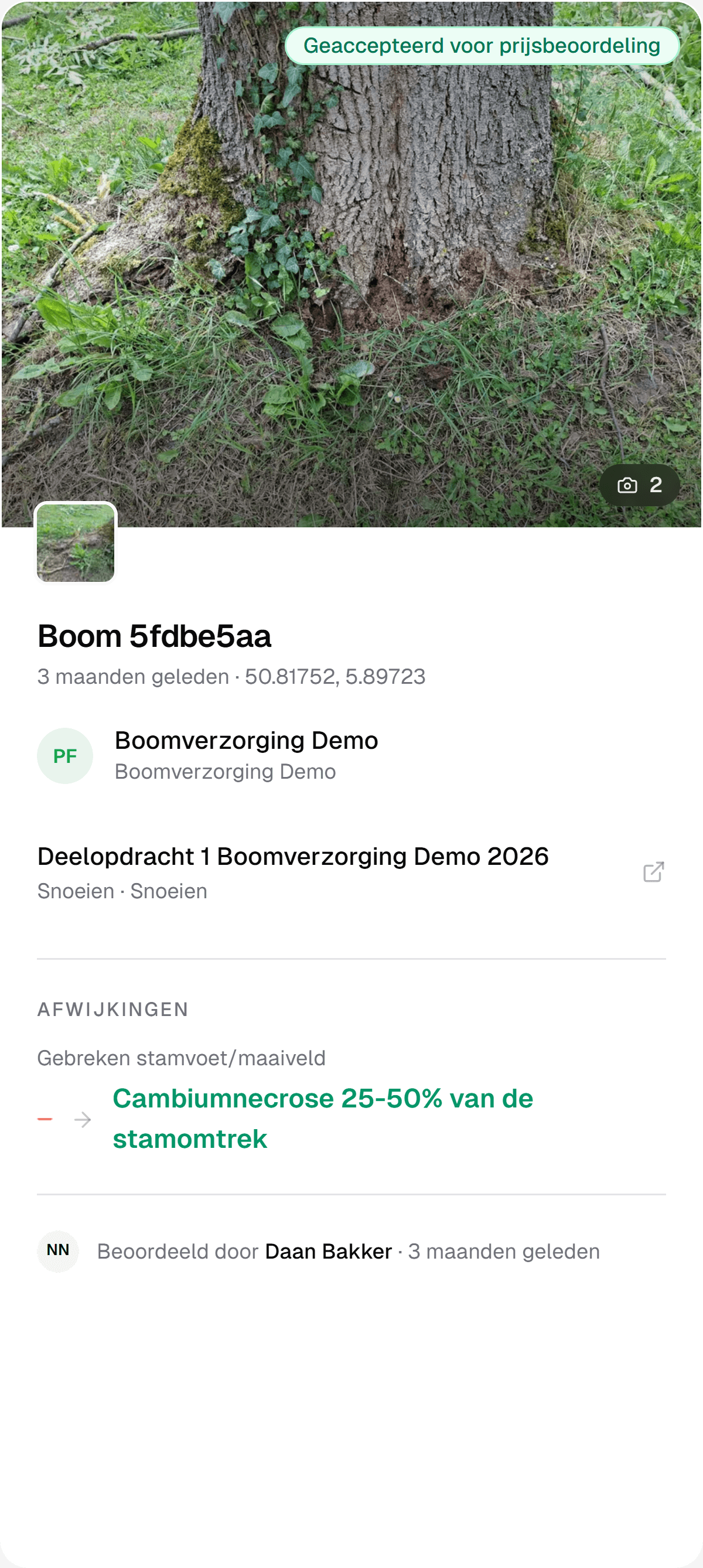
You export the timeline per tree as a PDF, with photos and approved deviations. If someone in the field sees something that does not match the register, they report a deviation (Afwijking melden) with mandatory proof photos. It only counts after a manager has approved it.
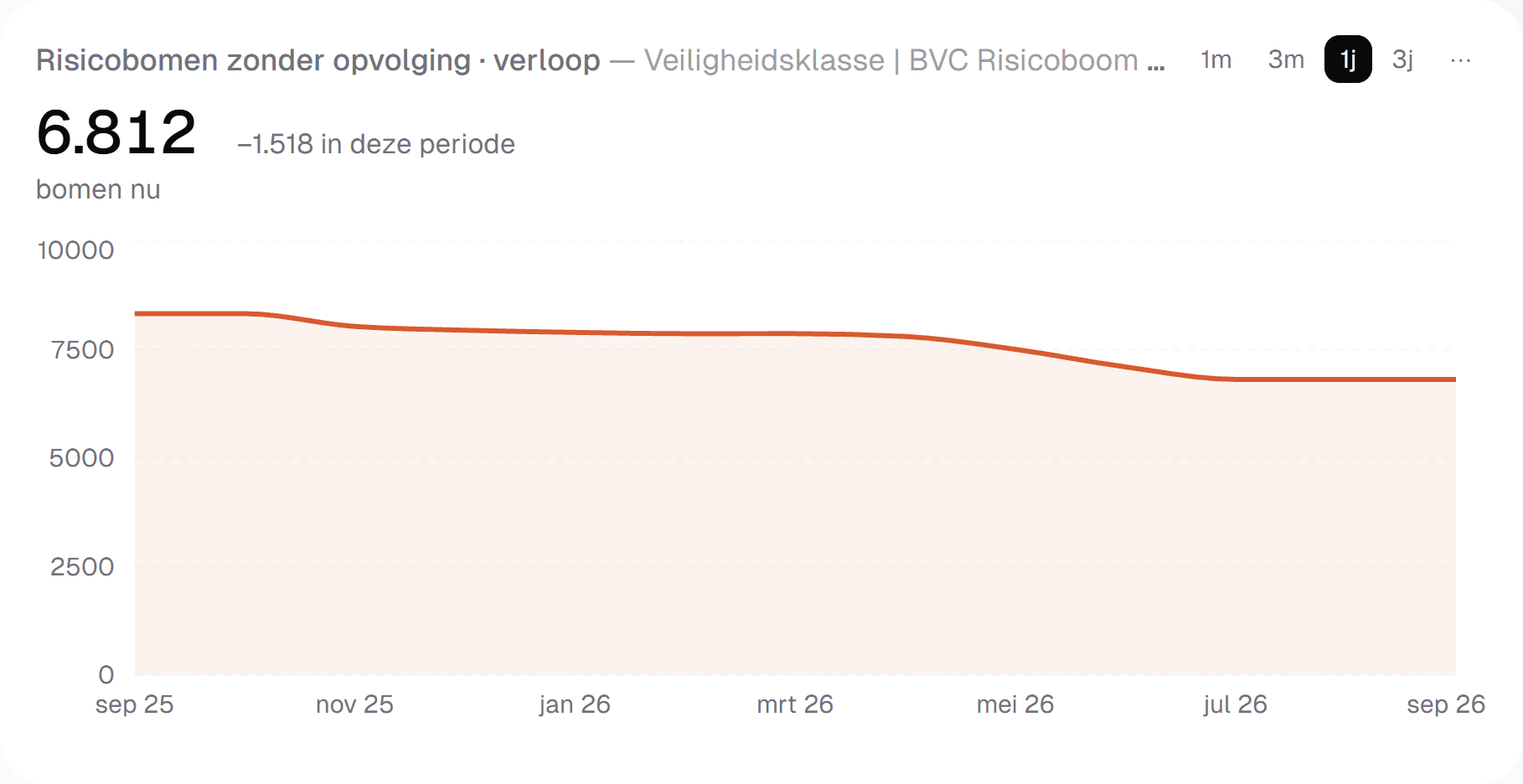
For the follow-up you colour the map by safety class or by follow-up, and put a chart of the risk trees that are still waiting on the dashboard. With a selection on the date of the last inspection you see which trees are due. The policy stays yours; the proof is in the register.
How that goes on the day itself, from the notice of liability to the exported dossier, is in the scenario on the tree dossier for a damage claim. And how you set an order when there are more risk trees than budget is in prioritising risk trees.
Frequently asked questions
Not automatically. The municipality is liable if it breached its duty of care: if it did not inspect the tree, or not enough, or left a known defect as it was. Whoever suffered the damage has to substantiate that. If the municipality can show a recent inspection without defects, the damage usually stays with the injured party or their insurer.
Dutch law sets no interval for that. Municipalities lay down the frequency in their own policy, depending on age, condition and location. In Dutch case law and municipal policy you come across once every two to four years for ordinary trees and yearly where the danger is heightened, but those are examples and not a norm. The frequency has to be explainable, and you have to be able to show that you keep to it.
The heightened duty of care (verhoogde zorgplicht) is about the place and the tree: where many people come, or where a tree is large or weakened, you inspect more often. The duty to investigate (onderzoeksplicht) is about one tree for which a defect or a sign of a hidden defect has been found. You have to examine that tree more closely, and make it safe in the meantime where needed.
Yes: you can contract the work out, but the duty of care stays with the owner of the tree. So the municipality itself has to be able to show when trees were inspected, what was found and what was done about it. Have the contractor record in the municipality's register, not only in a report of their own. In IDA Bomen they do, with access per project.
Yes. The line saying that a tree was inspected on a certain date and had no defects is the proof you need if a branch breaks off later after all. Without that line you cannot show that the inspection took place. IDA Bomen keeps every inspection in the tree's timeline, with the date and the inspector, also when nothing was found.
Read on
What is a tree safety inspection (BVC)?
A tree safety inspection (BVC in Dutch) is the visual check of a tree for defects that pose a danger. What you assess, record and follow up, and why.
4 min read
Storm damage from trees: who is liable in the Netherlands?
Under Dutch law a tree owner is only liable for storm damage if the duty of care was breached. What a municipality does and records around a storm.
8 min read
Municipal tree management: how a local authority runs it
Municipal tree management runs from policy and management plan to inspection, maintenance and records. The cycle, the roles and where it goes wrong.
6 min read


See your own tree inventory in IDA
Send us your tree inventory, as a shapefile, an Excel list or whatever you have, and we will show IDA on your own trees, from your own file to the approval of field work.
Used by