Outsourcing tree maintenance: working with a contractor
Working with a contractor on tree maintenance comes down to three flows: the assignment, the report back of what was done per tree, and the settlement. It runs well when all three are about the same trees, in one tree inventory where you have the final say. This article describes practice in the Netherlands, where the contract is usually a RAW-bestek.
7 min read


How a municipality and a contractor work together on tree maintenance
Many municipalities outsource the maintenance of their trees. The municipality is the client and remains the owner of the trees. The contractor, usually a tree care company or a grounds maintenance contractor, carries out the work: pruning, felling, planting, watering, and sometimes the tree safety inspection as well. This article describes practice in the Netherlands, with the contract forms that are common there.
Three flows run between the two. The assignment goes from municipality to contractor: which trees, which work, done by when. The report back goes the other way: what was done per tree, and what the contractor found outside that differed from the tree inventory. And the settlement follows from those two: what gets paid is what was assigned and demonstrably carried out.
The cooperation is good when all three are about the same trees, in the same inventory. It runs stiffly when the assignment is a map, the report back a spreadsheet and the settlement a third list. Then you spend more time laying lists side by side than on the trees. In IDA Bomen the assignment, the report back and the cost under the contract sit with the same tree.
What you put in the specification
The agreements are in a specification or a framework agreement. In the Dutch green sector that is often a RAW-bestek: the Dutch standard form of specification, comparable to a bill of quantities. The RAW system (in Dutch) belongs to CROW, the Dutch knowledge platform for infrastructure and public space, and provides standard texts and provisions for contracts in civil engineering. The principle: the client describes what has to happen, where and under which conditions, and the contractor decides how. IDA imports your RAW-bestek, with items and prices. The prices you settle on then sit next to the trees they are about.
- Bill items
- The work, divided into items with a unit, a quantity and a price. For trees, for example, formative pruning per height class, per tree.
- Quantities
- How many trees per item. Those numbers come from your tree inventory, so they are as good as that inventory.
- Quality requirements
- What the work has to meet. Many Dutch specifications refer for this to Handboek Bomen, the reference work for tree care and tree inspection of the Norminstituut Bomen.
- Supervision and completion
- How the municipality checks the work, what happens in case of a shortcoming and when a part assignment is finished.
- Data
- What the contractor records per tree, in which system or format, when they deliver it and who owns the data. This part is missing rather often.
There are two main forms. In a specification by frequency or per measure, the municipality prescribes which tree gets which treatment. In a beeldbestek, an outcome-based specification, you agree a quality level and the contractor decides what is needed to reach it. With that second form the report back weighs even more. The municipality did not prescribe the work, but does have to be able to show per tree what was done to it.
There is more on that responsibility in the article on the duty of care for trees. How an outsourced inspection round runs when the inspectors work in your inventory is in the scenario on outsourcing tree inspections.
From assignment to completion
Put the assignment together
The tree manager picks the trees: a district, a road section, or all trees with a certain advice from the last inspection. Each tree comes with the work that has to be done to it.
Hand over
The contractor gets the trees on a map, with the data they need: species, height class, pruning form, particulars. Not the whole inventory, but everything about their assignment.
Carry out and record
The crew records per tree what was done, at the tree itself. If a tree cannot be done yet, because a permit is missing or there is a nest in it, it gets a status instead of silently being left over.
Report deviations
If the inventory does not match what is standing there, the contractor reports it with a photo: a different height class, a defect that was not in it, a tree that is gone.
Review
The supervisor assesses the work outside, the tree manager assesses the reports. What is approved goes into the tree inventory.
Settle
The settlement follows from what was recorded per tree, at the prices in the specification.
Where it grinds
Many discussions between municipality and contractor are not about the quality of the pruning. They are about data.
- The inventory does not match what is outside. The tree is in the class up to 6 metres, but is 9 metres tall by now and so falls under a more expensive item. Without a fixed way to report and assess that, it becomes a discussion afterwards, about hundreds of trees at once.
- The report back comes late, in its own format. A spreadsheet at the end of the season. Someone has to retype it, and until then your inventory is out of date.
- Nobody knows how far the work is. The tree manager phones to ask about progress, the foreman has to ask the crew.
- Skipped trees disappear. The tree that had a nest in it in March is still unpruned in October, and nobody has it on a list.
- The supervisor walks without data. They see a pruned tree, but not what the assignment was.
All five have the same cause: municipality and contractor each work in their own records. The solution is not more meetings, but one place where assignment, execution and review sit with the same tree. In IDA that is the project: the crew fills in the form at the tree, and a deviation arrives with a photo in your queue.
What is in it for the contractor
A shared system sounds like extra control over the contractor. In practice it gives them something too. They get an assignment that is correct, on a map, instead of a list of tree numbers. They record their work once, and that is at once their proof that it was carried out, with date and photo. And extra work caused by an inventory that is off is reported the moment they see it, with evidence, instead of having to be proven months later.
When choosing a system, check that the contractor needs no licence or installation of their own and that their people can use it without a course. More questions to ask are in the article on tree management software.
Working together in IDA
In IDA an assignment is a project: a group of trees, a type such as pruning, felling or BVC, and the form the crew fills in. You give access per project, to one person or to the contractor's whole organisation. They see their own projects and nothing else of your inventory.
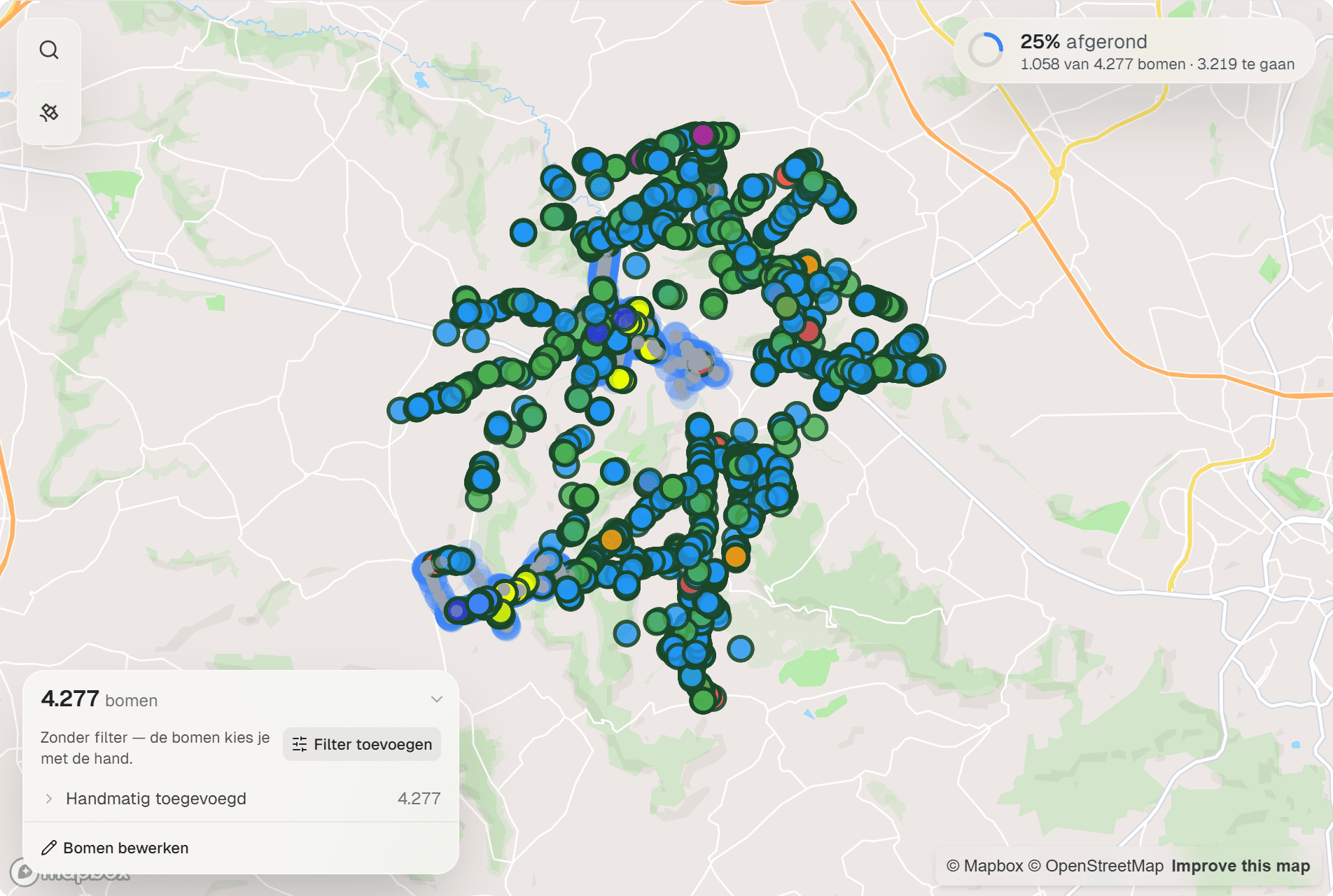
The crew works in a web app on a phone or tablet, without installation. Per tree they fill in the form, with the previous values already filled in and photos straight from the camera. A tree that cannot be done yet gets a status, such as “Wacht op vergunning” (waiting for a permit) or “Uitstel broedseizoen” (postponed for the nesting season). You see the progress on the project map: how many trees are finished, by whom, and how many days it still takes if the pace holds.

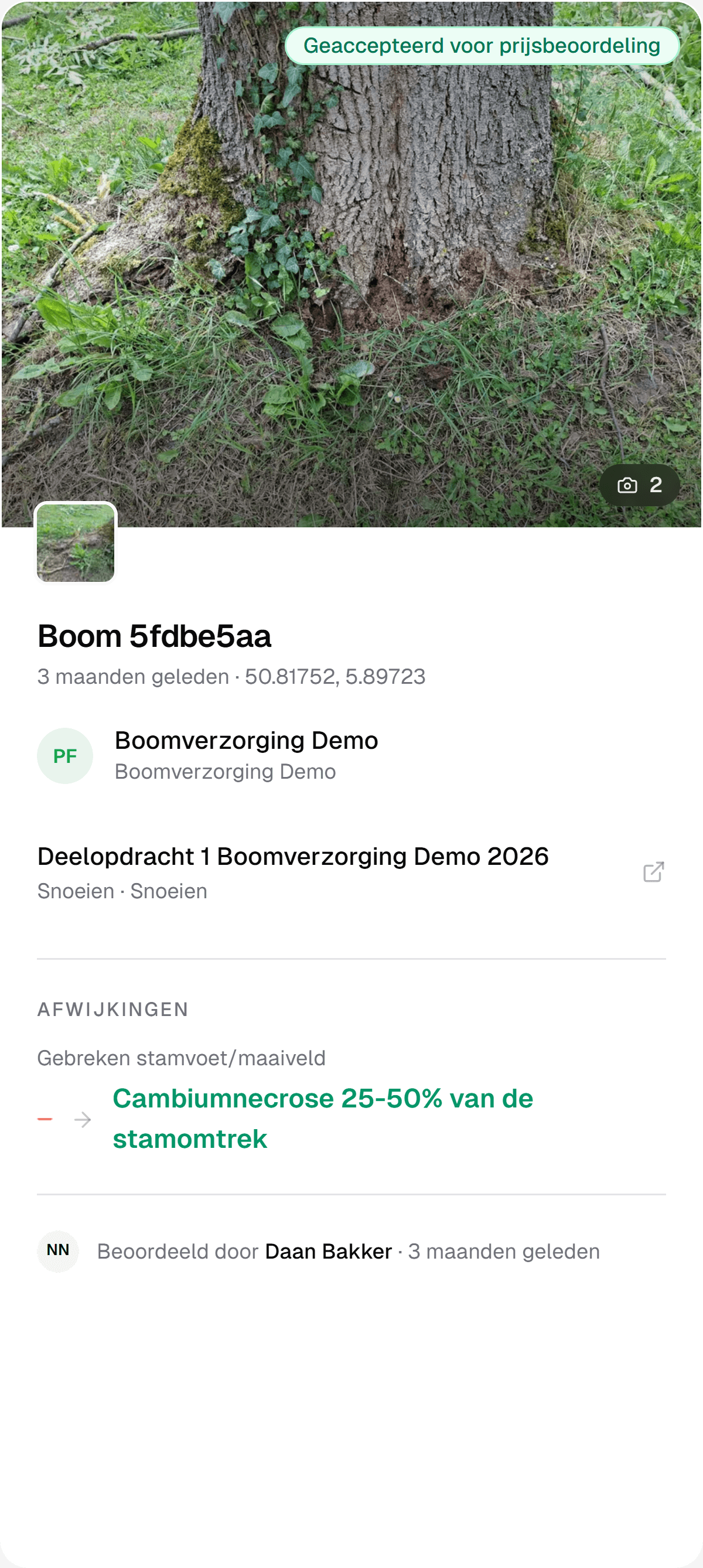
If the inventory is wrong, the contractor reports a deviation, with a proof photo. It lands in your queue. You see the photo, the old and the new value side by side, and who reported it. If you approve it, the new value enters the register, with the report as its source.
You link the items from the imported specification to attributes of the tree, such as pruning type and height class. IDA then works out for every tree in the project which item it falls under and what it costs. If a tree fits no item at all, you see that straight away, and not only at settlement. An approved deviation carries through at once: the tree that turned out to be 9 metres tall falls under the right item from that moment. That way you see the quantities and amounts you settle on.
Frequently asked questions
A RAW-bestek is a Dutch contract specification drawn up under CROW's RAW system: standard texts and provisions for civil engineering works, which also cover green maintenance. The work is divided into items with a unit, a quantity and a price, comparable to a bill of quantities. The client describes what has to happen, the contractor decides how. IDA Bomen imports your RAW-bestek and works out per tree which item it falls under.
In a frequentiebestek, a frequency-based specification, the municipality prescribes which work is done when. In a beeldbestek, an outcome-based specification, you agree a quality level and the contractor decides which measures are needed for it. For trees the latter means the contractor has to record well what they do per tree, because otherwise the municipality does not know.
The owner, so the municipality. The contractor is responsible for the quality of their work, but the duty of care for the tree does not transfer with it. That is why it matters that what the contractor sees and does outside reaches the municipality per tree.
That depends on what you agree, and not every specification says anything about it. Lay down that all data about your trees belongs to the municipality, in which format and when the contractor delivers it, and that you keep it when the contract ends. The simplest is for the contractor to work directly in the municipality's system. In IDA Bomen they do, with access to their own projects only.
Agree beforehand how the contractor reports a deviation: at the tree, with a photo, at the moment they see it. The tree manager reviews the report and adjusts the inventory. That way you settle on the actual situation. In IDA Bomen the contractor reports the deviation with a proof photo, and an approved deviation carries through at once in the cost of the tree.
Read on
Municipal tree management: how a local authority runs it
Municipal tree management runs from policy and management plan to inspection, maintenance and records. The cycle, the roles and where it goes wrong.
6 min read
Duty of care for trees: what Dutch municipalities record
In the Netherlands the duty of care for trees follows from article 6:162 of the Civil Code. When a municipality is liable, and what you record per tree.
8 min read
Tree management software: what it is and what to look for
Tree management software records your trees, inspections and maintenance on one map. What a tree management system does, and ten questions for any vendor.
7 min read


See your own tree inventory in IDA
Send us your tree inventory, as a shapefile, an Excel list or whatever you have, and we will show IDA on your own trees, from your own file to the approval of field work.
Used by