Handboek Bomen 2026 and 2022: the Dutch tree standard
Handboek Bomen is the standard of Norminstituut Bomen in the Netherlands, with quality requirements for all tree work in public space. The 2026 edition is the current one: the technical requirements are in essence those of 2022, the structure is new and data carries more weight.
7 min read
What Handboek Bomen is
Handboek Bomen is the Dutch standard for tree work in public space, published by Norminstituut Bomen, the Dutch standards institute for trees. The institute itself calls it “the norm for improving quality assurance around trees”: a collection of standardised quality requirements, guidelines and norms for work in, around and with trees. From design and planting to pruning, tree safety inspection, valuation and data recording. This article describes the Netherlands; the handbook's role in a contract is comparable to that of the British Standards for tree work in the UK.
The handbook is not a textbook but a book of agreements. A client refers to it in a specification (bestek in Dutch) or contract, and that fixes which requirements the work has to meet and how that is judged. Norminstituut Bomen itself lists as uses: contract specification, procurement of trees and substrates, quality assurance, the guide for the design of public space, tree policy and tree management. IDA Bomen works according to Handboek Bomen, from the classes in the form to the crown volume. Anyone who knows the handbook recognises the fields and the classes.
Who makes it and how you get it
Norminstituut Bomen publishes the handbook and revises it every four years. The content is validated by a committee of clients, contractors and training providers. A change is checked against the rest of the book, so that requirements in one chapter do not clash with those in another.
You use the handbook under a licence. Licence holders receive a printed copy and read it online in the Kennisbank of Norminstituut Bomen (in Dutch), the institute's knowledge base. At the end of 2024 the institute counted almost 500 licence holders, 270 of them municipalities, according to the trade magazine Boomzorg.
Is Handboek Bomen mandatory?
No, not by law. Handboek Bomen is a private standard. It becomes binding the moment you refer to it: in a specification, a framework contract, a guide for public space or your own tree policy. From then on a contractor can be held to it, and so can you as the client.
Mind the edition in that reference. A contract that names “Handboek Bomen 2022” keeps referring to that edition until you agree otherwise. At the launch of the 2026 edition, Norminstituut Bomen reminded licence holders to download the 2022 edition. For running contracts that remains the book you fall back on.
What is in it: twenty chapters
The 2022 and 2026 editions have the same structure: a chapter of supplementary provisions and then twenty chapters in three parts.
- Ontwerp en realisatie
- Design and construction, chapters 1 to 7: tree design, working around trees, supplying tree substrates, constructing planting sites, supplying (avenue) trees, planting, and aftercare and establishment guarantee.
- Beheer en zorgplicht
- Management and duty of care, chapters 8 to 13: pruning, specific (formative) pruning, tree safety inspection, tree safety investigation, felling and stump removal, and transplanting.
- Inventarisatie, taxatie en onderzoek
- Inventory, valuation and investigation, chapters 14 to 20: data recording, tree value, Bomen Effect Analyse (BEA, tree impact assessment), transplantability survey, planting site survey, quality assessment, and the tree balance with the Landelijke Bomennorm, the national tree norm.
For tree managers two chapters are the daily work: chapter 10 on the tree safety inspection and chapter 14 on data recording. With those two also comes the Data Inspecteur Bomen certificate of Norminstituut Bomen, for those who carry out tree safety inspections and record them digitally. It is valid for three years.
What the 2022 edition brought
Handboek Bomen 2022 was launched on 19 May 2022 in Gouda. Three chapters were added: planting site survey, quality assessment and tree balance. The biggest change was in the measure you count trees by. Tree crown volume (boomkroonvolume, BKV) became the thread running through the book.
BKV is the volume of the crown in cubic metres: what a tree has now, or can reach if it has enough room above and below ground. The handbook calculates it from two attributes in your tree inventory: the tree height class and the crown diameter class. The thinking behind it is simple. The number of trees says little about what they do for cooling, air and water. One large, healthy tree delivers more than ten small ones. Replace a veteran tree with one young tree and the number stays the same while most of the crown volume is lost. IDA calculates the crown volume according to Handboek Bomen and checks it against the height measurements of the AHN, the national elevation model of the Netherlands. So next to the estimate from your register you see what was actually measured.
What is new in the 2026 edition
Handboek Bomen 2026 is the current edition. Norminstituut Bomen launched it on 21 May 2026 at its national user day in Den Bosch. According to the institute the technical requirements have not changed, but have been sharpened where needed. What did change:
- One publication, two books. The norms and quality requirements are separate from the explanation. On the left you read what is required, on the right the explanation and context. The requirements part is much thinner as a result: in the table of contents the institute showed at the launch, the list of definitions starts on page 432 in 2022 and on page 255 in 2026.
- The Landelijke Bomennorm is included. Chapter 20 is now called “Bomenbalans en Landelijke Bomennorm”. The norm expresses the tree stock of an area in BKV per square metre and in tree canopy cover, in four levels. The highest level, the target value, is at least 2.2 m³ BKV per m² and 30 per cent canopy cover or more.
- A sharpened, validated list of definitions, which is at hand in the Kennisbank while you read.
- A validated tree species list of about 800 species, with the tree size per species, through the Kennisbank.
- More weight on data. The attributes are aligned with IMBOR, the Dutch information model for managing public space, and there is a standard exchange format (Standaard Uitwisselingsformaat, SUF) Handboek Bomen for exchanging tree data between systems.
- Calculation models and value. The models of the calculation program Boommonitor for BKV and planting site are included, and for the value of the benefits of trees in euros the handbook refers to EuroTrees.
- Different chapter names. Chapter 15 is called “Boomwaarde” (tree value) instead of “Boomtaxatie”, chapter 12 “Kappen bomen en rooien stobben” instead of “Vellen bomen en rooien stobben”.
Norminstituut Bomen has not made more than this public. What was sharpened per requirement is in the handbook itself. The announcement of the launch (in Dutch) is on the institute's site.
What it means for your tree inventory
The line from 2022 to 2026 is clear: the handbook is more and more about data. For a tree manager four things follow from that.
- Record in the handbook's classes. Tree height class, stem diameter class and crown diameter class are the input for BKV, tree balance and Bomennorm. A register with classes of its own has to be converted first.
- Keep your inventory complete and current. A tree balance shows how many trees and how much crown volume a project has, gains and loses. That only works if the baseline is right. See mapping a tree inventory.
- Make sure your data can be exchanged. Contractors and consultancies supply data and take it away. When looking at tree management software, ask about open export formats and about the link with IMBOR. In IDA you export your tree inventory yourself, to shapefile, Excel and the other common formats.
- Choose an edition deliberately in new contracts, and name it.
Handboek Bomen in IDA
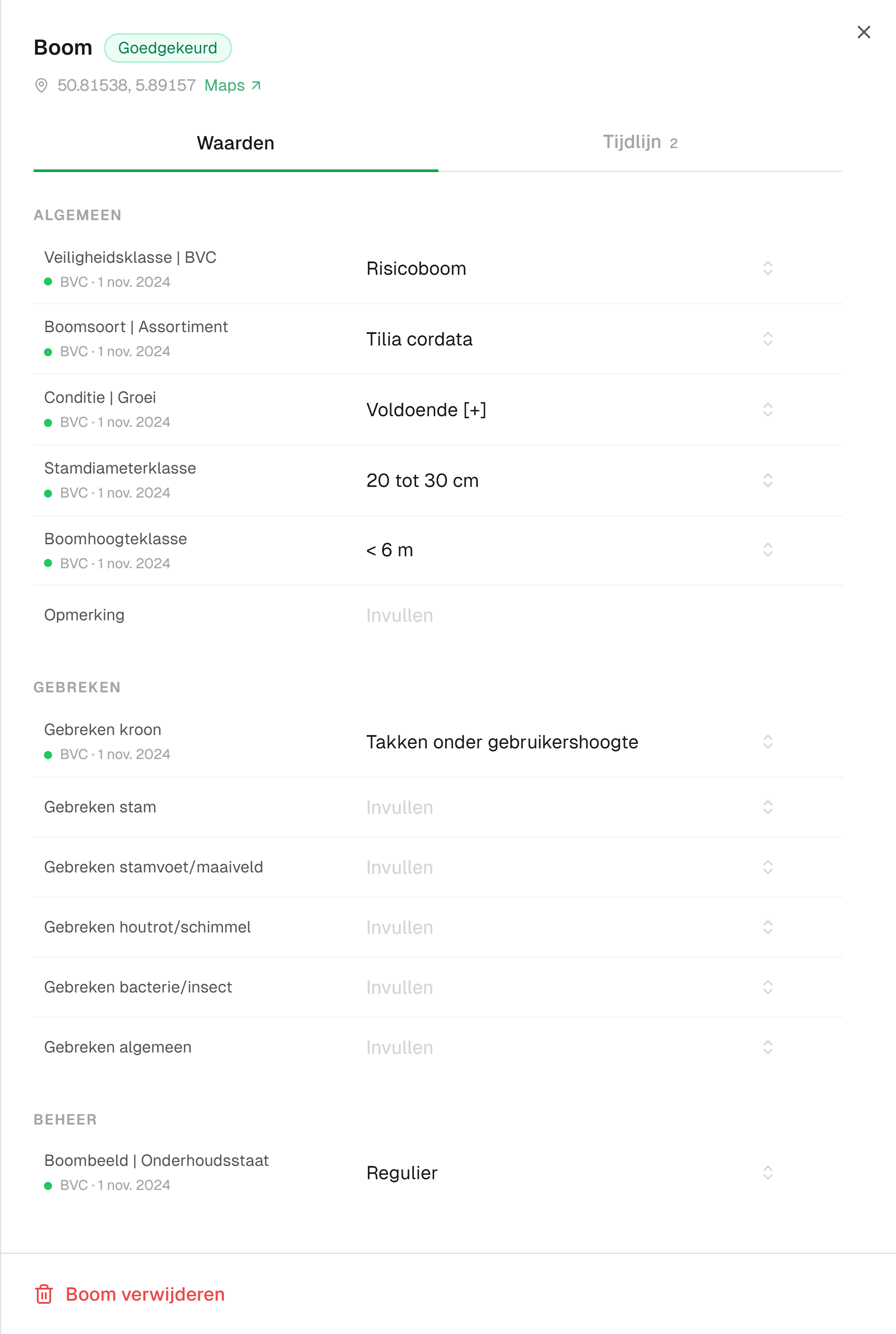
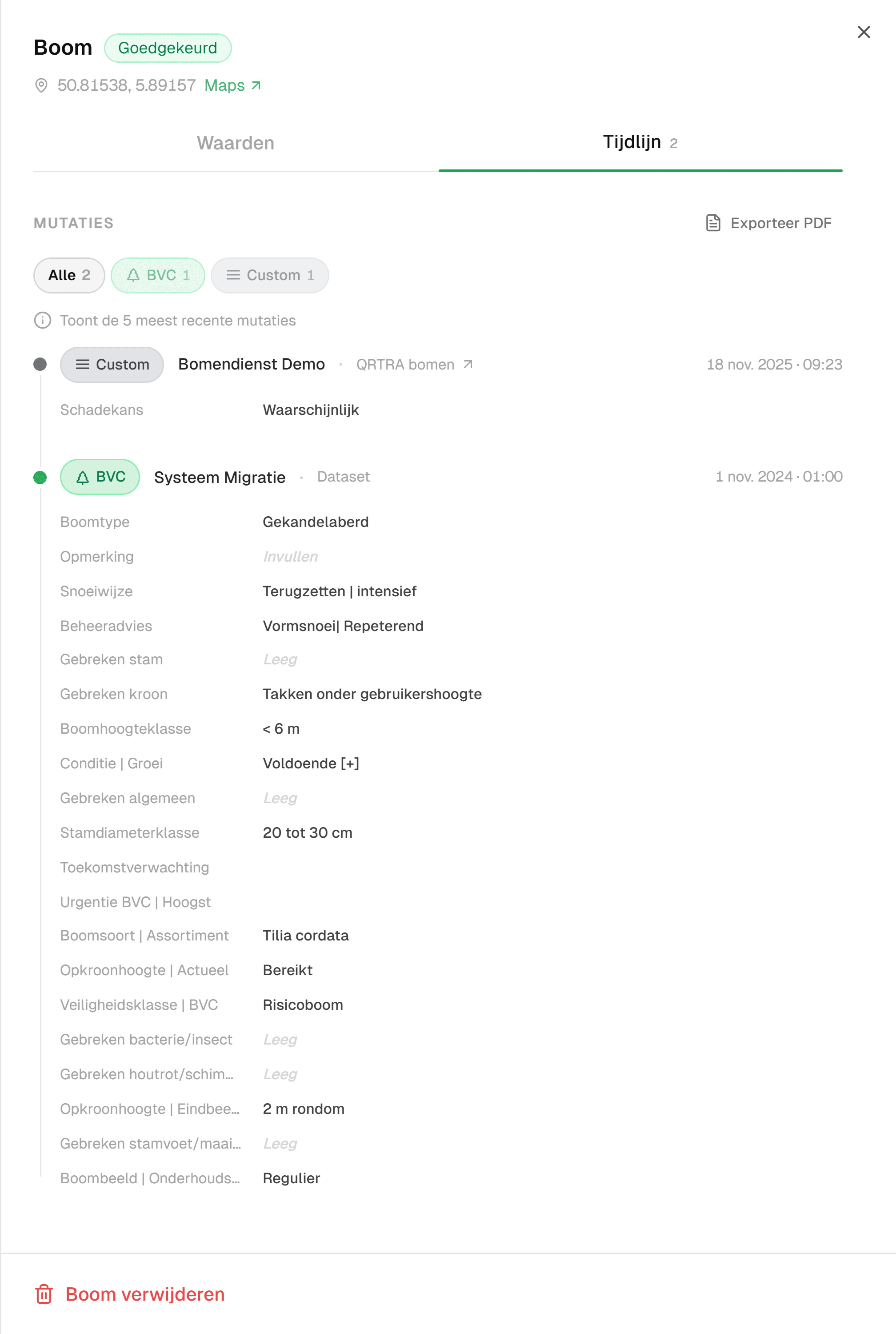
The standard form for the tree safety inspection in IDA uses the attributes and classes tree inspectors know from the handbook: safety class (Veiligheidsklasse), condition, species, stem diameter class, tree height class, defects per part of the tree, crown clearance, urgency and management advice. Under each value it says which inspection it comes from and when.
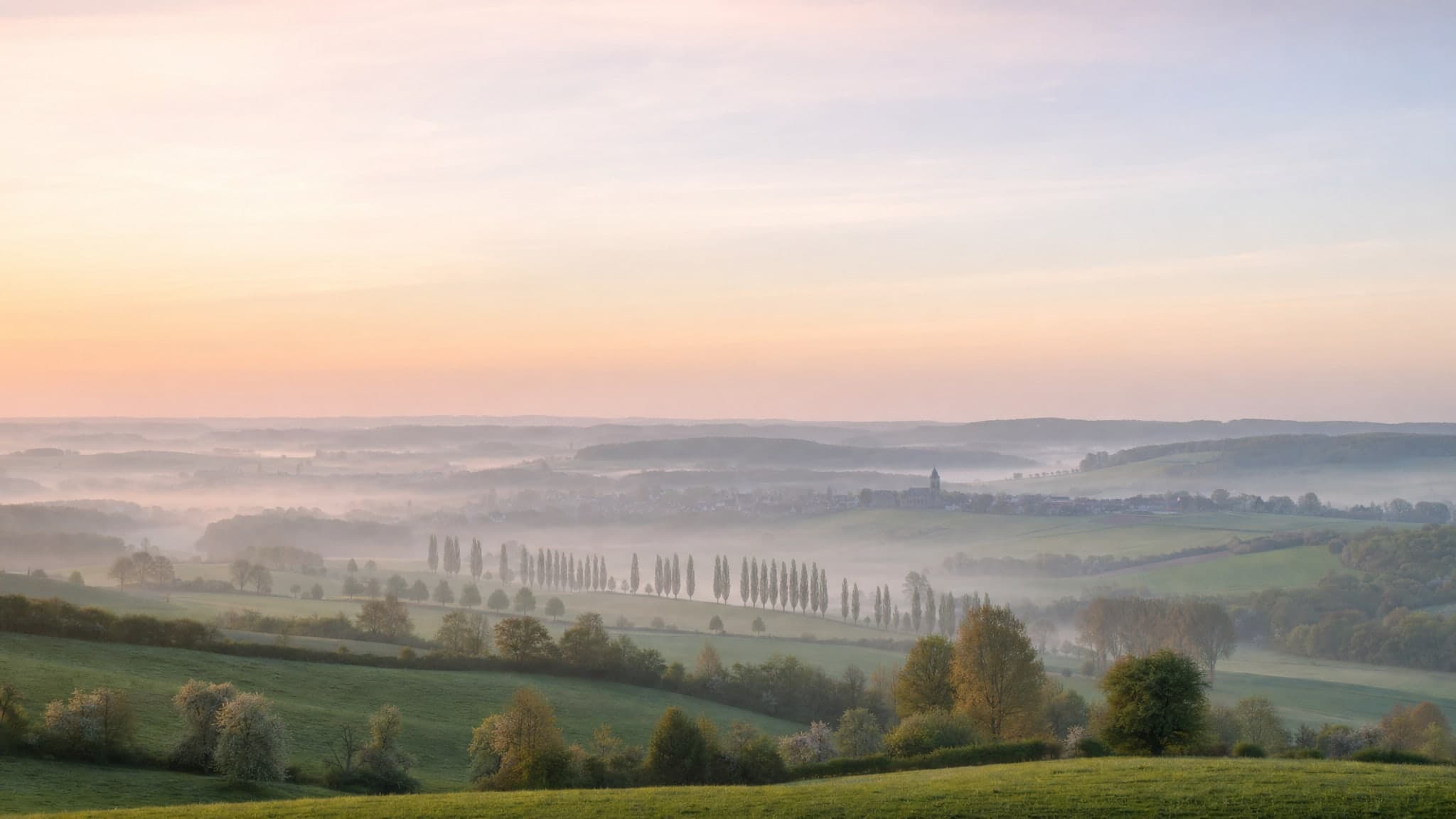
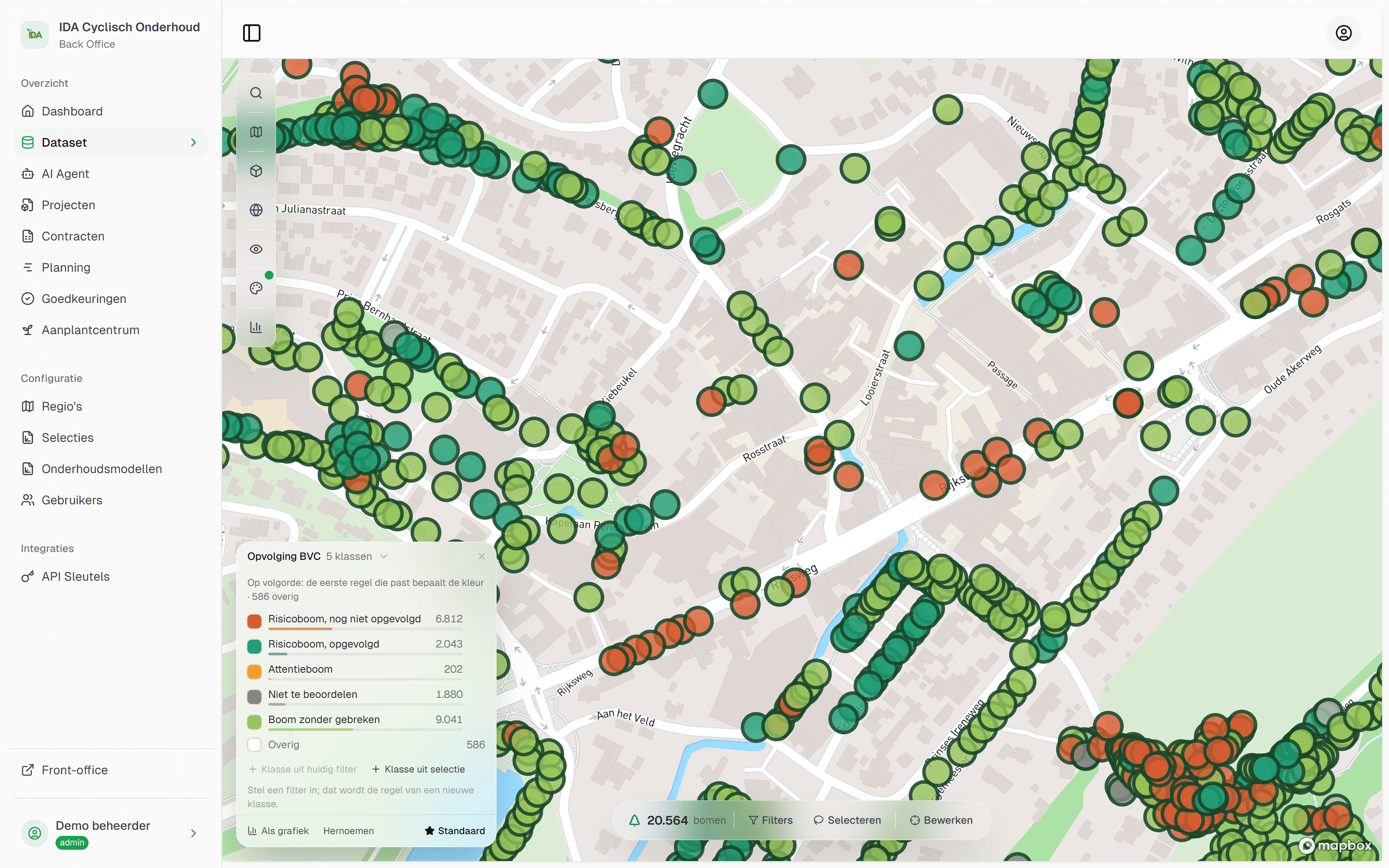
IDA shows the crown volume on a dashboard. You see the total, the trend over time, and which part of the end state is already there.
With an export per project, a contractor or consultancy can carry on with your data.
Frequently asked questions
Handboek Bomen 2026. Norminstituut Bomen launched this edition on 21 May 2026 in Den Bosch, four years after the 2022 edition. Licence holders received a printed copy and read the handbook online in the institute's Kennisbank (knowledge base), where the 2022 edition is still available too.
For contracts that refer to the 2022 edition it does: they keep referring to that edition until you agree otherwise. For new specifications and new policy the 2026 edition is the obvious choice. Name the edition in every contract, and there is no discussion about which requirements apply.
Tree crown volume (boomkroonvolume, BKV) is the volume of a tree's crown in cubic metres: what the tree has now, or can reach with enough room above and below ground. Handboek Bomen calculates it from the tree height class and the crown diameter class. Since the 2022 edition it is the measure the handbook uses to express the value of a tree inventory, instead of the number of trees. IDA Bomen calculates the crown volume according to Handboek Bomen and checks it against the height measurements of the AHN, the Dutch national elevation model.
The Landelijke Bomennorm, the Dutch national tree norm, is a reference for how much tree crown an area should have, expressed in tree crown volume per square metre and in canopy cover. The norm has four levels; the target value is at least 2.2 m³ BKV per m² and 30 per cent cover or more. Since the 2026 edition the norm is part of chapter 20 of Handboek Bomen.
We know of no certificate from Norminstituut Bomen for software. The institute certifies people, such as the Data Inspecteur Bomen. With software the point is whether the register uses the handbook's attributes and classes and whether the data can be exchanged. IDA Bomen works according to Handboek Bomen: the form for the tree safety inspection uses the handbook's classes, and the crown volume follows its calculation method.
Read on
What is a tree safety inspection (BVC)?
A tree safety inspection (BVC in Dutch) is the visual check of a tree for defects that pose a danger. What you assess, record and follow up, and why.
4 min read
Duty of care for trees: what Dutch municipalities record
In the Netherlands the duty of care for trees follows from article 6:162 of the Civil Code. When a municipality is liable, and what you record per tree.
8 min read
How to create a tree inventory: from survey to register
Creating a tree inventory: which data you record per tree, how you survey trees, bring in existing data and keep the inventory current. Dutch practice.
7 min read
See your own tree inventory in IDA
Send us your tree inventory, as a shapefile, an Excel list or whatever you have, and we will show IDA on your own trees, from your own file to the approval of field work.
Used by